Showing posts with label flock. Show all posts

Friday, April 22, 2011

The completely makeshift, almost operational chicken barrier


 Although we're having the coldest April on record, it was time to put the chicks outside during the day. To introduce new chickens into an existing flock, you let the two groups live for a while where they can see each other but not interact. Since I have only one chicken run, I made a barrier across one end and put the food and water dishes inside an old bird cage so that Bazooka and Maewest could feel more secure. (The pink thing is a food dish left in to give the chicks something to look at.)
They liked their new feeding station in the corner, protected by a tarp. In the evening, I brought them back to their box, now in the garage.


The older hens kept to their side for several days.


Until one day--
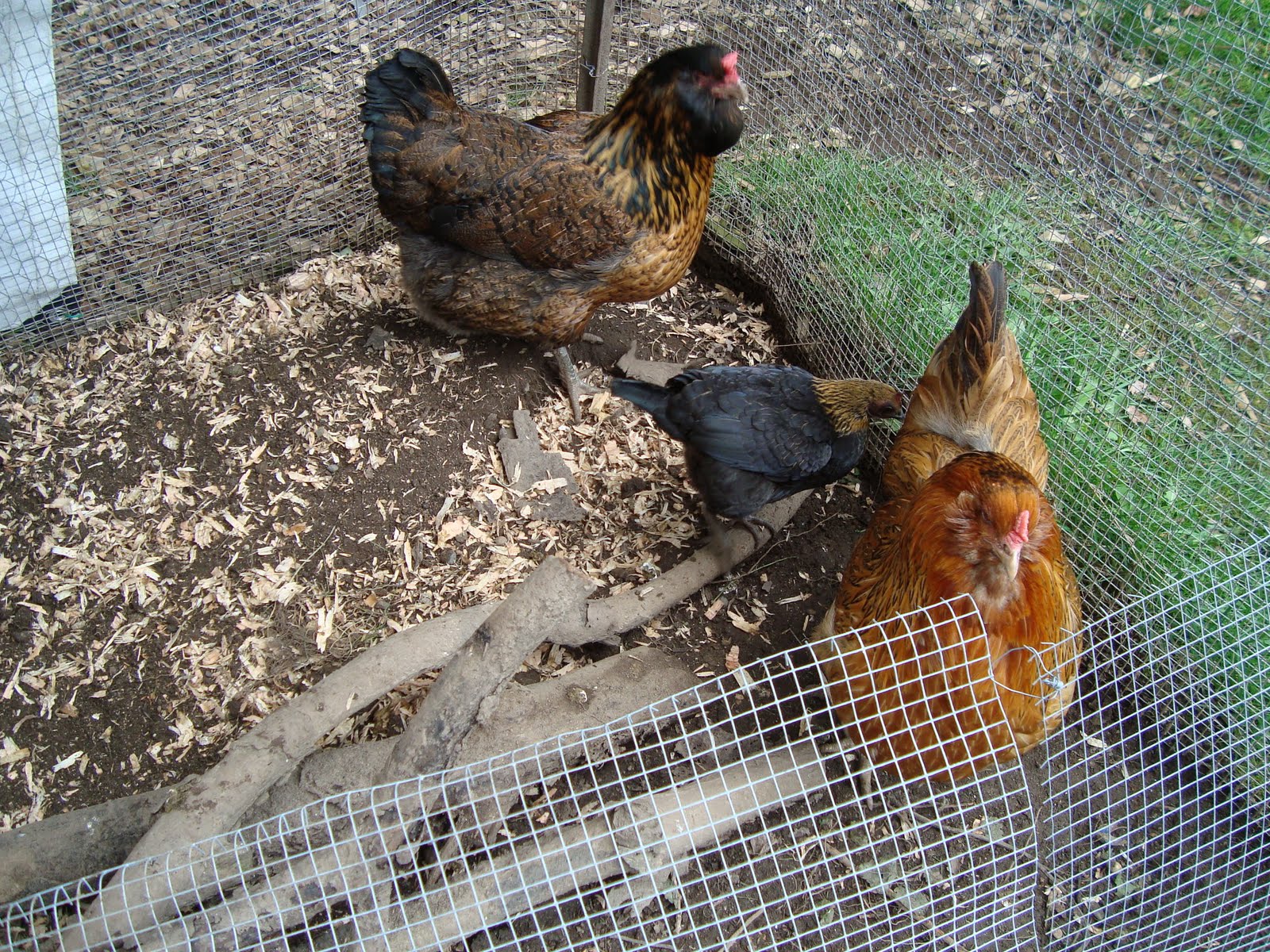
-- they couldn't resist finding out what was on the other side. They all hopped over to the little chicks' side and then, in the way of chickens, couldn't figure out how to get back to where they'd started. I had to take down part of the barrier and now they all play chicken, with the big ones chasing the little ones out because the little ones' food must be tastier--though it's the same stuff-- and then the little ones rushing back in when the big ones exit.

I hope they get used to each other soon.

Tuesday, November 20, 2007

Are your chickens happy?

Most people who have stood around watching chickens have seen them play what we call chicken football. A chicken finds a worm, calls out, “Wowser, a yummy worm,” and takes off running with it in her beak while all the others chase after her, trying to get it. There’s also a scientific term for it: worm running.

Scientists at Washington State University stood around watching a lot of chickens do a lot of running—17 flocks of 12 White Leghorns in each flock. They studied the chicks at 8-12 days old and at 68-70 days old. They used fake worms because all a chicken needs to trigger the behavior is an object that sticks out on each side of its beak and looks wormy.

The point of the study was to find out if there was any correlation between the bird that gets the worm and its rank in the flock. They did not find one. The study also noted that when a chick found a “worm,” she uttered particular sounds that called attention to the prize. The set of behaviors associated with worm running suggested that the chicks were not seriously competing for the prize. Instead, they were exhibiting “play behavior.”

One study cannot definitively prove that chickens play. But chicken keepers can declare that worm running is a game because we’ve seen the chickens at it and we find it very entertaining to watch them run full-out, switching directions so quickly that you’d think they’d fall over.

Given that unhappy critters don’t feel playful, the authors suggest—in more formal terms—that if you see your chickens playing football, they’re a happy flock.

Source:
Cloutier, S., Newberry, R., Honda, K., 2004, Comparison of social ranks based on worm running and aggressive behaviour in young domestic fowl, Behavioural Processes, #65, 79--86